








Suede and Chamois Leather: What's the Difference?

Have you ever wondered what the real differences are between suede and suede? At first glance, they may seem similar materials, but in reality, they hide different origins, processes, and characteristics. In this article, we'll discover what distinguishes suede from suede, highlighting its advantages and applications.
What is Suede: Definition and Characteristics
Contrary to what you might think, suede also called suede or velours (velvet in French) does not indicate a skin from a specific animal, but a particular processing applicable to different types of leather, such as Bovine, sheep, or goat.
By sanding the inner surface or split of the leather, a soft, velvety surface is obtained, with a characteristic rough feel, similar to suede. This process enhances otherwise less valuable leathers, giving them elegance, durability, and uniformity.
Suede can be further treated with oils and waxes to improve its waterproofness while maintaining its characteristic softness, or it can be embossed to achieve unique decorative effects. Designers, artisans, and fashion brands choose suede to create accessories, footwear, and clothing intended for frequent use, thanks to its versatility, ability to accommodate deep colors, and ease of processing.
Chamois Leather: What It Is
Suede, on the other hand, is a true natural leather obtained from the hides of animals such as chamois, deer, or reindeer, mostly protected species and subject to specific regulations to ensure their preservation. Unlike suede, which is a process mainly applicable to cattle or goats, suede is obtained by working the external part of the skin, the so-called grain, by sanding, to create that soft, velvety and slightly rough surface to the touch that makes it unique. Precisely because of the protection of the animals from which it derives, the diffusion of suede is more limited than other types of leather, making it even more exclusive and valuable for high-end projects.
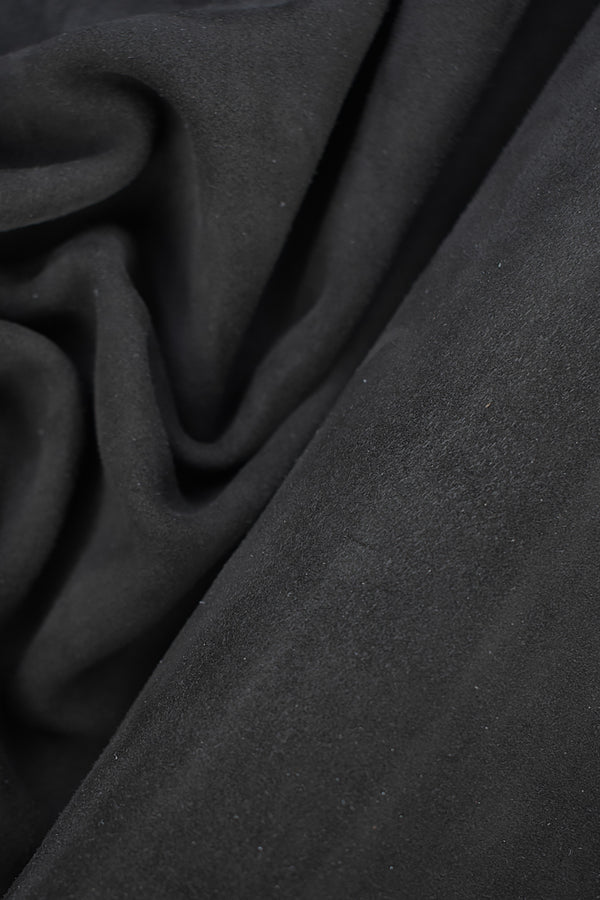
Main differences between suede and suede
When comparing suede and suede, it is therefore important to keep in mind that, despite their similar appearance, the two types of leather have different origins and characteristics. Let's review the main differences together:
-
Origin:
- Chamois leather: obtained from animals such as chamois, fallow deer, or reindeer.
- Suede leather: This process is mainly applicable to cattle or goats. -
Type of processing:
- Suede leather: The grain, the outer surface of the leather, is worked by buffing.
- Suede leather: The split of the leather is worked, buffing it to obtain a velvety effect. -
Appearance and feel:
Both types of leather have a soft, velvety surface, but suede maintains more premium natural characteristics, while suede is uniform and more resistant to everyday use. -
Distribution:
- Suede: Less common because it comes from protected species, making it more exclusive.
- Suede: More common, easy to find, and versatile for a variety of applications.
Buy Suede Online
Buying suede online offers numerous advantages: you can easily compare types, thicknesses, and colors, choose precise quantities, save time by avoiding travel, and have the material delivered directly to your workshop or atelier. The convenience of digital purchasing also allows you to access high-quality leathers, even those that are difficult to find locally.
On Zerow, these advantages become concrete: you can purchase suede selected from high-quality and sustainable materials, recovered from surplus stocks of major fashion houses. The platform allows you to choose rolls of different sizes and thicknesses, with sales by the meter and direct delivery, guaranteeing uniformity, durability, and professional quality.


