






Check fabric: a guide to the types of checks and how to use them
A guide to check fabric: gingham, madras, tartan, Prince of Wales and houndstooth, how to tell them apart and how to cut and match them.

Check fabric is any cloth whose pattern is made by stripes crossing at right angles in the warp and the weft. The scale of the squares, the number of colours and the weave give each check its name: gingham, madras, tartan, Prince of Wales, houndstooth or windowpane. Each one has a typical fibre and a natural home, from summer shirting to tailoring.
This guide explains the main types of check, how to tell them apart, how to cut and match them, and where to find them among Zerow's deadstock fabrics: surplus cloth from Italian luxury houses and mills.
What are the main types of check fabric?
The checks you will meet most often are gingham, madras, tartan, Prince of Wales (glen check), houndstooth, windowpane and buffalo check. They differ in the size of the square, the number of colours and whether the pattern is built in the loom. Here is a quick reference.
| Check | What it looks like | Usual fibres | Typical uses |
|---|---|---|---|
| Gingham | Even two-colour squares, often with white | Cotton, linen, blends | Shirts, summer dresses, childrenswear |
| Madras | Bright multicoloured checks | Lightweight cotton | Shirts, shorts, summer jackets |
| Tartan | Stripes of several colours and widths, the same in both directions | Wool, wool blends, viscose | Skirts, jackets, coats |
| Prince of Wales | Small checks and houndstooth grouped into larger squares | Worsted or woollen cloth, flannel | Suits, trousers, tailored jackets |
| Houndstooth | A broken check with pointed, jagged edges | Wool, blends, jacquard | Jackets, coats, skirts |
| Windowpane | Thin lines forming large squares on a plain ground | Wool, flannel | Jackets and suits |
| Buffalo check | Large two-colour blocks | Flannel, melton | Overshirts, workwear, blankets |
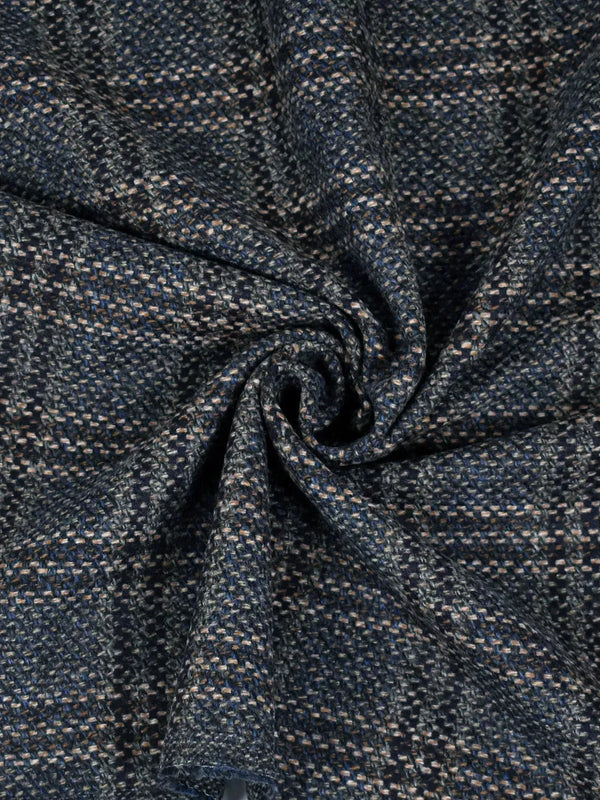

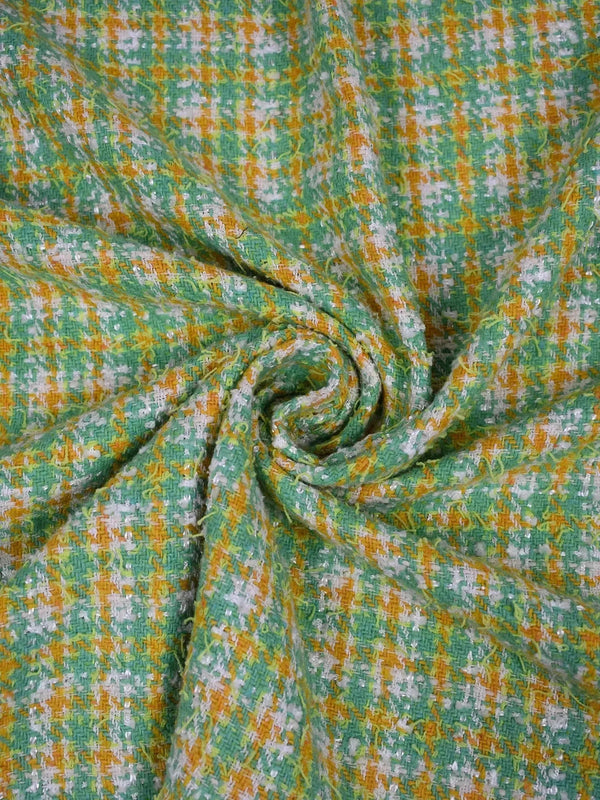


Gingham and madras: light checks for shirting
Gingham and madras are the warm-weather checks: light cottons or linens made for shirts, dresses and childrenswear. Gingham uses two colours in an even grid, while madras mixes many colours in a looser, more relaxed pattern.
Gingham, called vichy in much of Europe, is woven with coloured and white yarns in the same sequence in warp and weft. Where two coloured yarns cross you get a solid square, where colour meets white you get a lighter tone, so every gingham shows three shades. Squares range from a few millimetres to well over a centimetre, and the scale changes the character of the garment far more than the colour does.
Madras takes its name from the Indian city now known as Chennai. It is a fine, airy cotton in vivid multicoloured checks and suits casual summer shirts better than formal pieces.
Both are in our gingham fabric selection, which also includes wool ginghams for transitional tailoring.


Tartan: the classic winter check
Tartan is a check made of stripes in several colours and widths, repeated identically in warp and weft. Traditionally woven in wool, it belongs to autumn and winter: kilts and skirts, jackets, coats and scarves.
The repeating stripe sequence is called the sett. Many tartans are linked to Scottish clans, families or institutions and are recorded in the official Scottish Register of Tartans. Classic tartan is a wool twill, which softens the lines of the pattern; today you will also find it in viscose, blends and knits.
For history and uses, read our guide to tartan fabric, or browse our tartan fabrics.
Prince of Wales, houndstooth and windowpane: tailoring checks
Prince of Wales, houndstooth and windowpane are the checks of classic tailoring, cut into suits, jackets, trousers and coats. Their colours are quiet (greys, black, white, browns), and from a distance the cloth can almost read as plain.
Prince of Wales check
Also called glen check or Glenurquhart check, it groups small checks and blocks of houndstooth into larger squares, often with a fine coloured overcheck. It owes its name to Edward VII, who made it fashionable while he was Prince of Wales. It remains the reference suiting check, in worsted or flannel.
Houndstooth
Houndstooth, or dogtooth, is a broken check: the corners of each square stretch into points. It is woven in a twill with groups of two colours alternating in warp and weft; the small version is known as puppytooth. See our houndstooth fabrics in melton, jacquard and wool blends.
Windowpane
Windowpane is made of thin lines that frame large squares on a plain ground, like the panes of a window. It adds structure to a jacket without weight and often sits over a glen check.


Check, plaid or tartan: what's the difference?
Check is the broad term for any pattern of crossing stripes. Tartan is a specific kind of check with a defined, symmetrical sett, usually in wool. Plaid is mostly American usage for tartan-like patterns; in Scotland a plaid is originally the blanket-like garment worn over the shoulder.
In practice, British suppliers tend to say check, while American ones use plaid for almost any multicoloured check. When you buy, the name matters less than the scale of the repeat and whether the pattern is woven or printed.
Woven or printed checks: how to tell
A good check is usually yarn-dyed: the pattern is created in the loom with yarns that are already coloured. A printed check is applied to the surface after weaving. Turn the cloth over to tell the difference.
A yarn-dyed check looks almost the same on both sides and the colour runs right through the yarn. A printed one has a paler, often white, reverse, and the pattern may sit slightly off-grain, which makes matching at the seams far harder.
Cutting and matching checks
To sew a check well you need to match the pattern at the main seams: centre front, side seams, pockets and sleeves. Cut in a single layer, follow the repeat and allow more fabric than you would for a plain.
- Check whether the pattern is balanced: a balanced check is the same in both directions and can be cut either way; an unbalanced one has a direction, so every piece must face the same way.
- Lay the cloth in a single layer and line up a dominant stripe with the grain.
- Mark the stripes on your pattern pieces at the notches, so the next piece lands on the same point of the check.
- Decide where the boldest stripe falls, at the hem or across the chest, and centre the check on front and back.
- Tack the seams or use a walking foot so the layers do not shift.
How much extra you need depends on the size of the repeat: very little for a small gingham, a good deal more for a large tartan. Work it out on the lay plan before you order.
Buying deadstock check fabric
Zerow sells deadstock check fabrics: surplus and end-of-run cloth from Italian luxury houses and mills, already made and so needing no new production. For buyers that means couture-grade quality in limited, often unrepeatable quantities. Once a roll is gone, that check may not come back.
Fabrics are sold by the full roll. There is also a selection of fabrics cut to length, usually from a minimum of 10 metres: the details of each fabric, including how it is sold, are on the product page. Businesses with a VAT number have dedicated terms, and samples are available to everyone.
Checks are grouped by type: gingham fabrics for shirting and light dresses, tartan fabrics for winter pieces and houndstooth fabrics for jackets and coats. For fibres and weaves, see our guide to the types of fabric.
Shop deadstock tartan and check fabrics
Check fabric FAQs
Is gingham the same as vichy?
Yes. Gingham is the English name and vichy the name used in France, Italy and much of Europe for the same even two-colour check, usually in cotton.
Is Prince of Wales check the same as glen check?
They are close relatives. Glen check (Glenurquhart) is the pattern of small checks grouped into larger squares; Prince of Wales usually refers to a glen check with a coloured overcheck, though the two names are often used interchangeably.
Is houndstooth a check?
Yes, it is a broken check. The squares are woven in a twill so their corners stretch into points, which gives the pattern its jagged look.
How much extra fabric do I need to match checks?
It depends on the repeat, the distance after which the pattern starts again. As a rule of thumb, allow at least one extra repeat for each piece you need to match lengthways, and check it on your lay plan.
Can I order a sample before buying?
Yes, samples are available to all Zerow customers, private and business. It is the best way to judge the scale of the check, the colours and the handle before ordering.


