






Lace fabric: what it is, types (guipure, broderie anglaise, Chantilly) and how to sew it
A guide to lace fabric: what it is and how it is made, the main types, guipure and broderie anglaise, materials, sewing and care.

Lace fabric is an openwork textile in which the design is formed by the threads themselves: looped, knotted, twisted or embroidered, with no solid ground cloth. It was once made entirely by hand, with a needle or bobbins; today it is almost always machine-made, in cotton, silk, viscose or synthetics such as polyamide and polyester. The types most used in dressmaking are guipure (macramé), broderie anglaise, Chantilly and stretch lace.
This guide is for dressmakers, designers and brands. It covers what lace is and how it is made, the main types, guipure and broderie anglaise in detail, what lace is made of, how to sew it, and where to find deadstock lace on Zerow.
What lace is and how it is made
As Britannica explains in its entry on lace, it is an ornamental openwork fabric that developed in Europe in the 15th and 16th centuries. There are four main techniques:
- Needle lace: the motif is built stitch by stitch with a needle and a single thread.
- Bobbin lace: many threads wound on small bobbins are plaited over a pattern pinned to a pillow.
- Machine lace: since the 19th century, Leavers and Raschel machines have reproduced traditional laces industrially.
- Embroidered lace: the design is embroidered on a base that is then cut away or dissolved, as in broderie anglaise and guipure.
Types of lace fabric
| Type | Character | Typical uses |
|---|---|---|
| Guipure (macramé) | Raised motifs joined by bars, with no net ground | Dresses, tops, skirts, appliqués |
| Broderie anglaise | Embroidered, cut-work cotton, often with a scalloped edge | Shirts, summer dresses, childrenswear |
| Chantilly | Very fine net ground with delicate floral motifs | Bridal, lingerie, overlays |
| Valenciennes | Fine, flat lace, often as trim | Edgings, lingerie, finishes |
| Stretch lace | With elastane, close-fitting and comfortable | Lingerie, bodysuits, fitted dresses |
| Embroidered or sequinned lace | Enriched with embroidery, beads or sequins | Evening and occasion wear |


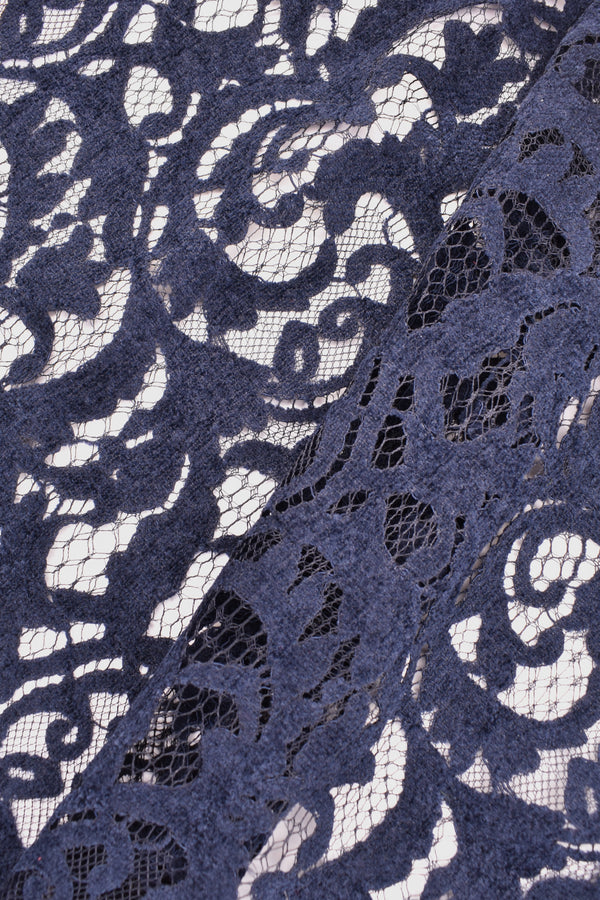
Guipure lace: what it is and what it is used for
Guipure, known in Italy as macramè lace, is embroidered on a soluble base that is then dissolved: only the raised motifs remain, joined by small bars, with no net ground. The result is full-bodied, well defined and stable enough to hold its own shape. It is used for dresses, tops and skirts, often over a contrasting lining, and for appliqués on collars, cuffs and necklines.
Broderie anglaise: the cut-work cotton
Broderie anglaise, known in Italy as sangallo after the Swiss embroidery town of St. Gallen, is a light cotton cloth machine-embroidered with cut-work motifs, often with a scalloped edge. It is cool, breathable and easy to wash, so it is used for summer shirts, dresses and skirts, childrenswear and trims.
What lace is made of
- Cotton: cool and natural, typical of broderie anglaise and many guipures.
- Silk: the material of the finest laces, light and luminous.
- Viscose: soft, with good drape.
- Polyamide and polyester: strong, stable and easy-care, widely used in machine lace.
- With elastane: for stretch lace and lingerie; more in our guide to stretch fabric.
How to sew lace
- Plan a lining or slip in silk, viscose or nude tulle if the lace is sheer.
- Place the motifs before cutting: centre the flowers on the front and use the scalloped edge for hems and necklines.
- Cut a single layer at a time, following the outline of the motifs where possible.
- For invisible joins, overlap the pieces and stitch by hand or with a small zigzag along the motif, then trim.
- Use a fine 60/8 to 70/10 needle and fine thread; press on the wrong side, on low heat, with a cloth.


Where to buy deadstock lace fabric
Zerow sells deadstock lace: surplus and end-of-run cloth from Italian luxury houses and mills, already made and so needing no new production. Quantities are limited and often unrepeatable: once a roll is gone, that lace may not come back.
Fabrics are sold by the full roll. There is also a selection of fabrics cut to length, usually from a minimum of 10 metres: the details of each fabric, including composition and how it is sold, are on the product page. Businesses with a VAT number have dedicated terms, and samples are available to everyone.
Our lace collection includes guipure, broderie anglaise, cotton, stretch and embroidered laces.
Lace fabric FAQs
What is guipure lace?
A lace embroidered on a base that is then removed, leaving only raised motifs joined by bars, with no net ground. It is full-bodied and stable, ideal for dresses and appliqués.
What is the difference between lace and broderie anglaise?
Broderie anglaise is a kind of lace: a cotton cloth that is embroidered and cut through. Lace in the strict sense is built entirely from threads, like Chantilly or Valenciennes.
Does lace need a lining?
Usually yes, if the garment needs to cover: a silk, viscose or nude tulle lining shows off the pattern and makes the piece wearable. Some full-bodied guipures can be used unlined.
How do you wash lace?
By hand or on a delicate 30 °C machine cycle in a laundry bag. Dry flat and press on the wrong side on low heat.
Can I order a sample before buying?
Yes, samples are available to all Zerow customers, private and business. It is the best way to judge pattern, handle and colour before ordering by the roll or cut to length.


