






Full grain leather: meaning, top grain and split
A guide to full grain leather: meaning, top grain, split and nubuck, how to recognise it, pros and cons, types, uses, price and care.

Full grain leather is leather that keeps its top layer, the grain, intact: it has not been sanded, buffed or corrected, so it shows the animal's natural grain with pores and small irregularities. It is the finest and strongest quality, and the one that develops a beautiful patina over time.
This guide is for leather goods makers, shoemakers, designers and brands. It covers what full grain means, how it differs from top grain, split and nubuck, how to recognise it, pros and cons, the main types, uses, why it costs more, how to care for it and where to find it among Zerow's deadstock leathers.
What does full grain leather mean?
After tanning, a hide is made of several layers. The outer one, which carried the hair, is the grain: its fibres are dense and tightly interwoven, making it the most compact and durable part, as Britannica explains in its overview of hide structure. Beneath it lies a looser, more fibrous layer, the corium or flesh side.
Leather is full grain when that grain is left whole, without being sanded to remove flaws. Full grain can be smooth, embossed, tumbled or finished in many ways: what matters is that the original surface has not been taken off.
Full grain, top grain, split and nubuck
| Type | How it is made | Character |
|---|---|---|
| Full grain | Grain left intact | Natural grain, the strongest, develops patina |
| Top grain / corrected grain | Grain lightly sanded and finished with a covering coat | More uniform look, flaws hidden, less breathable |
| Nubuck | Grain buffed into a short nap | Velvety and dense, more delicate than full grain |
| Split | Lower layer obtained by splitting the hide | No grain, less strong; often suede or coated |
For nubuck, read our guide to nubuck leather; for embossed and tumbled finishes, our guide to embossed and tumbled leather.
How to recognise it
- Visible, irregular pores and grain, not a perfectly repeated pattern.
- Small natural marks, such as wrinkles or faint scars, which are proof of an intact grain rather than defects.
- It feels warm and alive, without the plasticky effect of coated surfaces.
- On lightly finished hides, a drop of water darkens the surface slowly; on corrected grain it beads and runs off.
- The reverse shows fibrous flesh, as with all real leather.
Pros and cons
| Pros | Cons |
|---|---|
| The strongest and most durable | Costs more |
| Breathable and comfortable | Shows the natural marks of the hide |
| Develops a patina with use | Marks more easily than coated top grain |
| Natural, authentic look | Needs a little care |
Types of full grain
- Full grain calf: dense and strong, for bags, shoes and belts; see our guide to calfskin leather.
- Full grain lamb nappa: very soft, for garments and soft bags; see our guide to lambskin leather.
- Full grain goat: with a more pronounced natural grain.
- Full grain sheep and mutton, including vegetable-tanned or vegetable-washed.
- Embossed or glazed full grain: surface finishes that keep the grain intact.


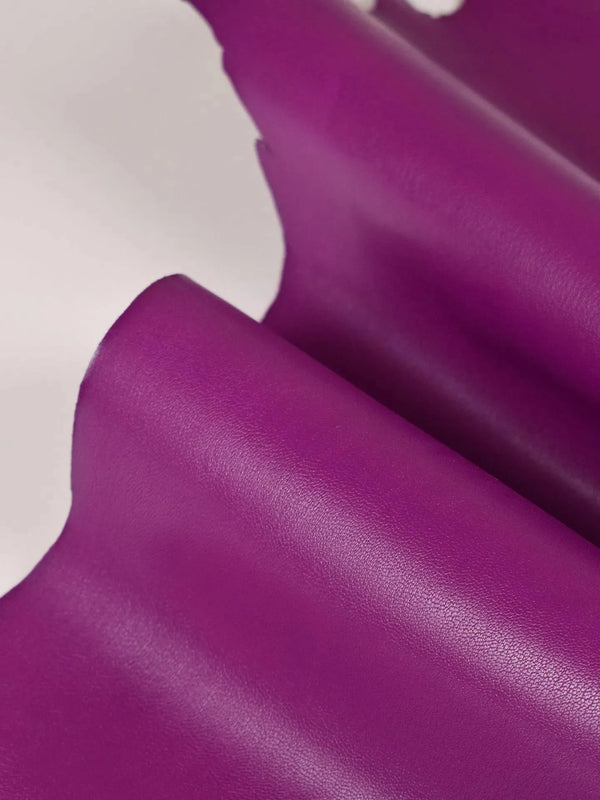
What it is used for
- High-end bags and small leather goods.
- Shoes, especially uppers for classic and handmade footwear.
- Belts and accessories built to last.
- Jackets and garments, in softer lamb.
- Fine upholstery and interiors.
Why full grain costs more
Keeping the grain intact requires hides with few flaws, which are a small share of those available; the rest are corrected or split. Full grain therefore needs stricter selection and more careful tanning, and that shows in the price. In return, it lasts longer and ages better. Deadstock gives access to this quality on better terms, because it is surplus that has already been made.
How to care for it
- Dust regularly with a soft, dry cloth.
- Condition occasionally with a product suited to the finish, testing it on a hidden spot first.
- If it gets wet, let it dry naturally, away from heat.
- Avoid long exposure to direct sun, which can darken or dry the leather.
- Embrace the patina: small signs of use are part of its appeal.


Where to buy deadstock full grain leather
Zerow sells deadstock full grain leathers: surplus and end-of-run skins from Italian luxury houses and tanneries, already made and so needing no new production. Quantities are limited and variants are rarely repeated: once a skin is gone, it may not come back.
Leathers are sold by the skin, so you choose how many skins you need. Each product page shows the average m² per skin, the thickness, the tannage and the other specifications. Businesses with a VAT number have dedicated terms, and samples are available to everyone.
Our full grain leather collection includes full grain calf, lamb, goat, sheep and mutton, smooth, embossed and vegetable-tanned. For an overview of all leathers, read our guide to the types of leather.
Full grain leather FAQs
Does full grain mean genuine leather?
Yes, and more: it means genuine leather whose top layer, the grain, has been kept intact. That layer is the strongest part of the hide.
Full grain or top grain?
Full grain is stronger, more breathable and ages better; top grain looks more uniform and costs less, but its coated surface does not develop a patina.
What is split leather?
It is the lower layer of the hide, obtained by splitting it: it has no grain, is less strong, and is usually made into suede or given a coated finish.
Does full grain scratch?
It can mark, especially in smooth, lightly finished versions, but light scratches often fade with a little rubbing and blend into the patina over time.
Can I order a sample before buying?
Yes, samples are available to all Zerow customers, private and business, leathers included. It is the best way to judge grain, handle and colour in person.


